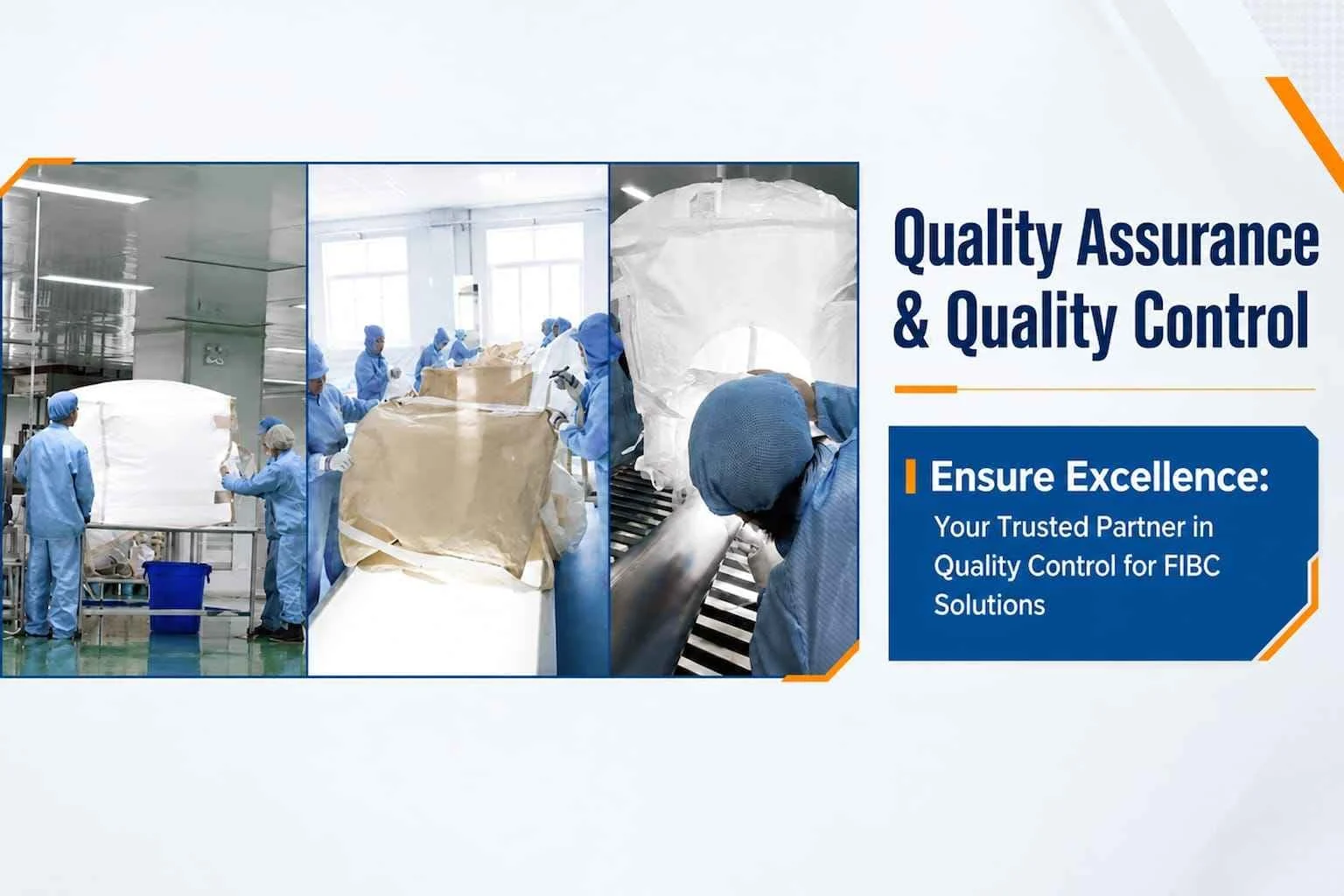
Zero Compromise on Strength.
Engineered FIBC Quality Control.
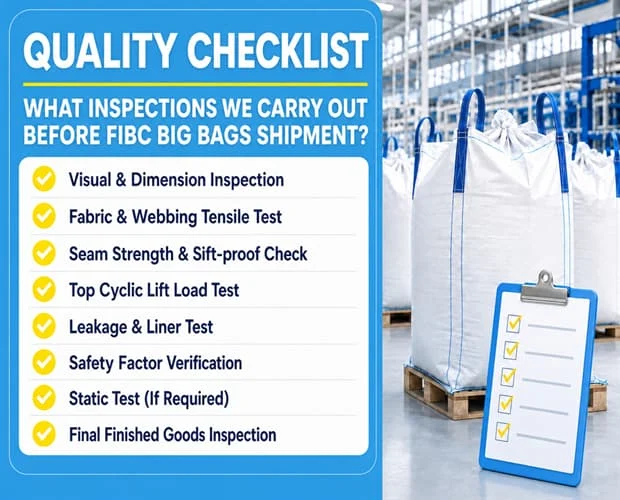
From incoming virgin polypropylene molecular testing to finished 1,000-tonne cyclic top-lift proofing. We operate an unbroken chain of 8 inspection gates, batch traceability, and formal tolerance governance so your bulk containers perform flawlessly in demanding transit.
- 100% Virgin PP Guaranteed (Zero Recycled Resin)
- 8 Mandatory In-House Inspection Checkpoints
- Batch-to-Resin Traceability Protocol
- In-House 1,000-Tonne Cyclic Top-Lift Rig
Strict anti-recycled material policy ensures maximum tensile integrity.
From resin granule MFI check to final hydraulic bale release.
In-house hydraulic safety factor proofing up to 6:1 multi-trip rating.
Physical fabric swatches & digital batch records preserved 24-36 months.
Inspection Architecture
The 8 Vertical Quality Inspection Gates.
Unlike packaging brokers who rely on visual exterior checks, QINFENG operates strict lab and line testing at every stage of production. Click any gate below to inspect testing parameters, tolerances and QA release criteria.
100% Virgin PP Raw Material & Additives Verification
Every batch of polypropylene resin is sourced exclusively from tier-1 petrochemical producers (Sinopec / PetroChina). Recycled resin is prohibited factory-wide. Melt flow index (MFI), density, moisture content, and masterbatch ratios are lab-verified before silo loading.
- MFI Melt Flow Index (2.5 - 3.8 g/10min)
- UV Masterbatch formulation check (1.0% - 2.5%)
- Supplier COA matching batch invoice
- Zero Recycled Polypropylene declaration
Tape Yarn Linear Density & Tensile Strength
Extruded PP tapes form the skeleton of the bag. Every 2 hours, automated tensile testing pulls yarn samples to verify tenacity (cN/dtex), denier consistency, and elongation percentage under high-speed stretching.
- Tape Tenacity ≥ 6.2 cN/dtex
- Elongation at Break: 18% - 25%
- Denier tolerance within ± 3.5%
- Thermal shrinkage rate test (< 4.5% @ 100°C)
Circular & Flat Fabric Weaving Density & GSM
Fabric rolls are examined under precision optical lights for missed picks, warp breaks, and oil contamination. Swatch cutters test fabric weight (GSM), warp/weft tensile strength, and air permeability across roll edges and centers.
- GSM Weight tolerance controlled within ± 3.0%
- Strip tensile strength (Warp & Weft ≥ 1800 N/5cm)
- Full roll continuous visual defect inspection
- Lamination adhesion peeling test (when coated)
Lifting Webbing Tensile & Cyclic Fatigue Audit
Lifting loops bear the entire cargo payload during crane and forklift operations. In-house heavy narrow-fabric looms weave high-tenacity belts tested for absolute breaking force, edge wear resistance, and stitch engagement strength.
- Loop breaking load: 15 kN - 35 kN per strap
- Webbing width & thickness micrometer validation
- Abrasion resistance testing over rounded pins
- Loop color fastness & UV endurance index
First-Piece (Golden Sample) Sign-off Protocol
Prior to mass line sewing, the head QA engineer and workshop supervisor assemble a complete unit from production cloth. Dimensions, print alignment, spout diameters, stitch pitches, and document pockets are verified against the signed technical specification.
- Body size & diagonal symmetry confirmation
- Print artwork, Pantone color, and warning labels
- Inlet/outlet spout length & tie string positioning
- Dual sign-off: QA Director + Lead Sewing Technician
Continuous In-Process Patrol (IPQC) & Stitch Integrity
Dedicated roving inspectors patrol sewing stations every 60 minutes. Needle counters check stitch density (10-12 stitches per 10cm), seam overlaps, dust-proof cord placement, broken needle reconciliation, and thread trimming cleanliness.
- Stitch frequency: strictly 10 - 12 stitches / 100mm
- Locking back-stitch reinforcement at all loop bases
- 100% Broken needle log and physical fragment recovery
- Sift-proof filler cord alignment inspection
Finished Bag Performance Proofing & Top-Lift Testing
Finished units are selected at random for rigorous performance testing on our in-house 1,000-tonne cyclic hydraulic rig. Bags are filled with test media and subjected to cyclic lifting (30 to 70 cycles) followed by a final catastrophic burst load test.
- Cyclic Top-Lift validation: 30 cycles @ 2x SWL
- Ultimate breaking load: min. 5x SWL (5:1) or 6x SWL (6:1)
- Seam shear and peel strength verification
- Discharge spout leakage & quick-release valve test
Cleanroom Folding, Baling & Final Release Sign-off
After vacuum cleaning and exterior visual inspection, bags are folded and compressed via 20-tonne hydraulic balers or palletized to ISPM-15 standards. Each bundle receives weather-resistant batch labels with QR/barcodes linking to production logs.
- Air blow vacuuming to eliminate loose thread ends
- Exact count validation per bale (no short counts)
- Heavy waterproof PE stretch wrapping & edge guards
- QA release certificate stamped by Head of Quality
Consistency Assurance
Bridging Sample Approval to Mass Delivery.
The most common industrial packaging failure is the "golden sample trap" — receiving a flawless pre-production sample, followed by sub-standard bulk cargo. Here is how QINFENG mathematically guarantees sample-to-mass repeatability.
Locked Technical Specification Sheet
The sample is not just a physical bag; it is translated into a 24-point engineering drawing specifying polymer resin grade, yarn denier, fabric GSM, webbing breaking load, stitch pitches, thread count, and folding dimensions.
Physical Golden Swatch Archiving
For every approved sample, twin swatches are retained in our climate-controlled QA sample archive for 24-36 months. One swatch remains in the central inspection lab; the counter-swatch hangs directly on the workshop line master board.
Shared Tooling & Machine Calibration
Samples are produced on the identical production extruders, circular looms, and heavy sewing machines that run the mass volume — never in an isolated manual craft lab with non-replicable handwork.
Order Governance
Strict Version Control for Drawings & Orders.
Verbal adjustments and chat messages are the primary cause of industrial delivery mistakes. QINFENG enforces a strict engineering change notice (ECN) system where all drawings, printing artworks, and packaging instructions carry unified revision numbers.
| Document Entity | Version Syntax | Control Rule & Approval Path |
|---|---|---|
| Technical Spec Sheet TSS Blueprint | QF-TSS-v2.1 |
Requires dual customer & engineering signature; supersedes prior versions upon receipt. |
| Print & Label Artwork Pantone & Logos | QF-ART-v1.4 |
Specifies Pantone C colors, warning symbols, UN codes, and exact placement coordinates. |
| Pre-Production Sample Physical Master | QF-SMP-2026-A |
Physical tag stamped with date, technician ID, and linked to order bill of materials. |
| Proforma Invoice (PI) Commercial & Incoterm | QF-PI-260309-R1 |
Governs quantity, trade terms (FOB/CIF/DDP), packaging method, and inspection protocols. |
| Packaging Instruction Bale/Pallet Specs | QF-PKG-v1.0 |
Specifies exact bags per bale, pallet dimensions, pallet stretch wrapping, and pallet tags. |
The 10-Item Production Gate Lock
A production run is frozen from modification the moment fabric cutting begins. Any amendment to dimensions, printing, or liners triggers an Engineering Change Notice (ECN) halting line operations until new files are re-signed by both parties.
- Chat messages cannot modify manufacturing parameters.
- Cost of scrapped customized materials is audited transparently.
- Delivery schedules adjust automatically upon ECN sign-off.
- All obsolete drawings are physically shredded on shop floors.
Mathematical Standards
Scientific Tolerance Governance.
In bulk packaging, claiming "zero tolerance" is technically dishonest, while loose tolerances cause filling jams and container devanning failures. QINFENG clearly defines and contractually binds manufacturing tolerances across all parameters.
Bag Body, Height & Spout Tolerances
Woven polypropylene exhibits natural textile elasticity. When bags are filled with granular cargo, slight bulging occurs. Body cutting and assembly follow tight metric dimensional limits to guarantee automated filling spout alignment and container cube fit.
| Body Width / Depth (Base) | ± 2.0 cm (± 20 mm) |
| Bag Body Cut Height | ± 3.0 cm (± 30 mm) |
| Inlet & Outlet Spout Diameter | ± 1.5 cm (± 15 mm) |
| Lifting Loop Free Height | ± 2.0 cm (± 20 mm) |
Fabric GSM, Coating & Total Bag Weight
Fabric GSM (Grams per Square Meter) determines burst resistance and rigidity. We monitor circular weaving tension and extrusion die thickness continuously to keep fabric weight strictly within certified parameters.
| Uncoated Fabric GSM | ± 3.0% |
| Extrusion Coating Layer (e.g. 30g) | ± 2.5 g/m² |
| Total Empty Bag Finished Weight | ± 4.0% |
| PE Liner Micron Thickness | ± 5.0% |
Stitch Pitch, Seam Margins & Overlap Standards
A bag is only as strong as its weakest seam. Over-stitching cuts polypropylene tapes; under-stitching causes powder leakage. Our automated and computerized sewing stations maintain strict stitch geometry.
| Stitch Density / Frequency | 10 - 12 stitches / 10 cm |
| Seam Edge Margin (Distance to Edge) | Min. 25 mm ± 3 mm |
| Loop Base Stitch Engagement Length | Min. 100 mm (10-12 back stitches) |
| Sift-Proof Felt Cord Compression | 100% continuous without gap |
Flexographic Printing Alignment & Pantone Accuracy
Industrial flexographic printing on textured PP cloth requires specialized non-smearing inks. We audit color consistency against Pantone Formula Guides and enforce mechanical placement limits on logos and barcodes.
| Color Deviation (Delta E) | ΔE ≤ 2.5 vs Approved Pantone |
| Print Placement Coordinate Drift | ± 10 mm from specified center |
| Registration Drift (Multi-Color) | ≤ 2.0 mm overlap precision |
| Rub / Abrasion Resistance Test | 50 rub cycles with zero ink peeling |
SWL & Safety Factor (Zero Negative Tolerance)
Unlike physical dimensions where slight bilateral variance is normal, load capacity operates on a ZERO NEGATIVE TOLERANCE rule. A 1,000kg SWL bag with a 5:1 rating must withstand 5,000kg without seam failure or strap slippage.
| Safe Working Load (SWL) | Zero negative tolerance (-0kg allowed) |
| Safety Factor Margin (SF) | Min. 5:1 (Single-trip) or 6:1 (Multi-trip) |
| Cyclic Top-Lift Durability | 100% survival @ 30 cycles (2x SWL) |
| UN Certified Dangerous Goods | Zero failure on drop test & topple test |
Digital Traceability Engine
Granule-to-Bale Batch Traceability.
If an issue occurs anywhere in your global supply chain, our digital batch tagging allows us to pinpoint the exact virgin resin batch, extruder operator, loom number, sewing technician, and testing record in minutes. Try the interactive simulator below.
Problem Resolution & CAPA
Transparent 4-Tier Non-Conformance Workflow.
How a manufacturer handles problems is the true test of partnership. When a customer inquiry or defect arises, we follow an ISO 9001 standard Corrective and Preventive Action (CAPA) protocol with documented root-cause findings.
Upon receiving a notification, video, or photo, the QA Director immediately quarantines the corresponding batch in the plant, reviews warehouse inventory, and issues a formal confirmation receipt to the customer within 4 working hours.
- Instant electronic quarantine order issued to production and warehouse teams.
- If safety-critical (e.g. strap slippage under load), client is advised to halt batch use.
- Digital dossier opened with dedicated QA Case Reference Number.
We cross-reference the batch number with our physical retention swatch and electronic line records. Tensile testers re-evaluate the retained fabric swatches and compare tensile curves against client photos.
- Archive swatch retrieved and re-tested on electronic tensile rig.
- Operator, loom number, sewing machine, and weather logs analyzed.
- Client cargo filling temperature, bulk density, and fork handling checked.
A joint technical conference between the Chief Engineer, QA Director, and Workshop Manager determines root causality using 5-Why analysis. A comprehensive 8D or CAPA report is submitted to the customer.
- Delineation of responsibility: Manufacturing, Transit shock, or Operating over-capacity.
- Written technical 8D / CAPA report with photographic microscopic analysis.
- Direct access to Chief Engineer for technical Q&A via video call.
Where manufacturing non-conformance is verified, QINFENG takes full accountability. Expedited remanufacturing, air-freight replacement, credit notes, or approved cash offsets are executed swiftly without bureaucratic evasion.
- Priority re-production line assigned within 48 hours for immediate replenishment.
- Credit deduction applied directly to next proforma invoice or balance.
- Tooling, machine program, or stitch recipe permanently updated on master drawings.
Partner with a True Manufacturer
Experience Transparent, Certified FIBC Quality.
Need complete quality assurance records, ISO 9001 certificates, or test reports for your procurement audit? Connect directly with our engineering team today.