The range the filed cement workflow is quoted on, matched to the fill weight the plant actually runs
Loose bulk density of dried silica sand as bagged; it sets the fill volume for a given weight
Coating, or a loose or glued-in PE liner, closes the weave where the bag sits in a humid yard
Holds a rectangular section on the pallet; a tubular bag is cheaper but bulges and stacks badly
THE 4 PACKAGING RISKS THAT DECIDE THE SPEC IN CONSTRUCTION & BUILDING MATERIALS.
Cement, dry mortar, graded sand and concrete washout each fail in a different way. These are the four risks the records filed under this industry name, and what we specify against each of them.
Cement And Mortar Taking Up Water
Cement sets hard and dry mortar cakes once the load takes up atmospheric moisture through an ordinary weave, so an uncoated, unlined bag in a humid yard can ruin the load before it is used.
Dust At The Fill And At The Seam
A fast cement fill dusts the filling point, and fine 0–1 mm sand and cement dust escape through a stitch line that is not sealed. The leak path is the seam and the spout, not the fabric body.
Abrasion, Puncture And Pallet Shape
Sharp quartz grains work on the fabric at the fill spout and in the bottom corners under road vibration, pallet nails and rebar puncture the base, and a tubular bag bulges instead of stacking.
Washout Leaving The Wash Point
Concrete washout is a small volume of water carrying a lot of solids. A bag that overflows, splits or stands where its base cannot drain puts alkaline washout water into drains, ground or standing water.
ENGINEERED FIBC CONSTRUCTIONS FOR CONSTRUCTION & BUILDING MATERIALS.
Configured for cement packing terminals, dry-mix lines, dried silica sand and wash points that move with the work.
U-Panel FIBC
A flat-bottom FIBC whose body is one U-shaped panel joined to two side panels, giving a squarer filled footprint than a tubular bag. It is the usual answer when a filled bag has to…
- Size: 75 x 75 x 110 cm up to 100 x 100 x 150 cm (typical)
- SWL / Safety Factor: 500 kg to 1,200 kg at 5:1; 6:1 on request
- Top: Open top, filling spout, duffel top, or skirt with tie cord
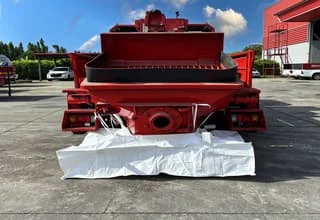 600 x 400 px
Keeps washout out of drains
Concrete Washout Bag
A fabric bag placed where concrete wagons are washed out, so solids settle and the water can be handled separately. It keeps washout out of drains and site ground; the water rules remain the…
- Size: 80 x 80 x 80 cm to 100 x 100 x 100 cm (typical)
- Fabric: Woven PP body with a porous base panel
- Top: Open top, reinforced, with a splash skirt
SPECIFIC APPLICATIONS & PROCESS FLOWS.
The packaging setups we have written up for cement packing terminals, dry-mix mortar producers, silica sand processors and contractors catching washout at the wash point.
Concrete Washout & Slurry Containment
Concrete washout and slurry intercepted where wagons, pumps and rigs are washed out: the bag holds the solids while they settle and set, and drains the water, which stays alkaline and stays the site's responsibility.
Cement & Dry Mortar Packaging
Bagging cement and dry mortar at a batching plant or a dry-mix line: the bag has to survive…
Silica Sand Packaging
A mineral processor bagging dried silica sand into 1.0-1.5 t lots must keep every bag inside the crane…
TESTING, COMPLIANCE & QUALITY ASSURANCE.
What the cement, sand and washout workflows ask us to hold to, and how each is checked before the bags ship.
1. Requirements & How We Verify Them
| Fill Weight Against SWL | The SWL on the bag is checked against the fill weight the plant actually runs, because dried sand holds its fill volume and an overfill arrives at the quay as crane load. |
|---|---|
| Seam Construction | Seam construction and stitch count inspected on production samples against the approved drawing; on cement dust and fine sand the leak path is the stitch line. |
| Liner And Closure | Liner material and the fill-port closure confirmed against the storage conditions you give us, and how the liner is closed at the fill head. |
| Drainage And Set Load | On washout bags, the base drainage panel and the lifting loops are checked against the set load rather than the wet volume. |
2. The Configuration Range We Quote
| U-Panel FIBC · Size | 75 x 75 x 110 cm up to 100 x 100 x 150 cm (typical) |
|---|---|
| U-Panel FIBC · SWL / Safety Factor | 500 kg to 1,200 kg at 5:1; 6:1 on request |
| Concrete Washout Bag · Size | 80 x 80 x 80 cm to 100 x 100 x 100 cm (typical) |
| Concrete Washout Bag · Fabric | Woven PP body with a porous base panel |
Each row is the range its product record states; the confirmed figure is set per project.
Construction & Building Materials Quotation Checklist
- 1. Volume of washout per wash:
- How much water and solids one washout produces, and how often the bag is filled.
- 2. How the washout is discharged into the bag:
- Chute, hose or pump line, the height it falls from, and whether it is a single wash or a running cleanout.
- 3. How the drained water is collected:
- Where the water goes after it leaves the bag, whether a tank, bund or an authorised discharge point, which stays with your site.
- 4. Where the wash point is and whether it moves:
- Ready-mix wagon wash, pump-line cleanout, precast yard or piling rig, and whether it stays in one place.
DELIVERED CONSTRUCTION & BUILDING MATERIALS CASE STUDIES.
What was proposed in this industry, how it was validated and what is confirmed so far.
U-Panel FIBC for Silica Sand: A GCC Building-Materials Distributor
How a GCC building-materials distributor replaced tubular bags with U-panel FIBCs to stop pallets leaning - and what is still unproven.
Read Case Study →